Betsabee Romero
Mexico, b. 1963
Betsabeé Romero is a Mexican contemporary artist known for her powerful and visually distinctive work that explores themes of migration, identity, memory, and cultural transformation. Born in Mexico City in 1963, she has built an international career through sculpture, installation, photography, and public art. Her work often incorporates everyday materials, most notably used tires and automobiles, transforming them into objects that carry deep symbolic meaning. Through these materials, Romero examines the movement of people and cultures, as well as the social and political realities tied to borders and displacement.
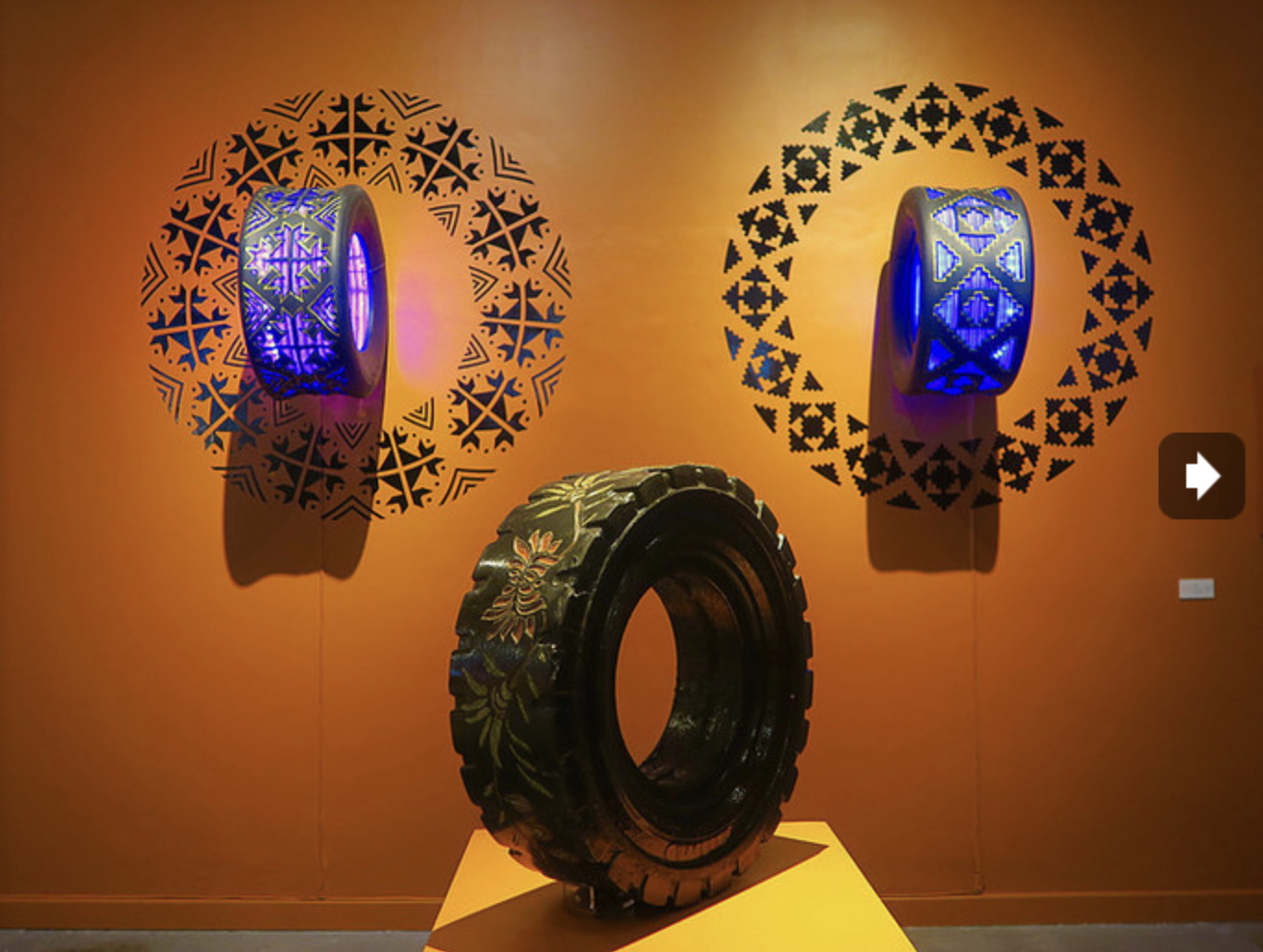
Romero studied communication and later pursued art history and visual arts in Mexico and Europe. This academic background helped shape her conceptual approach, allowing her to combine visual impact with critical thought. Rather than working within a single medium, she developed a multidisciplinary practice that emphasizes material as both form and message. Her choice of materials is central to her work. Tires, for example, are not simply industrial objects. They represent mobility, migration, and the constant movement of goods and people across territories. By carving, painting, or assembling them into sculptural forms, she transforms these objects into carriers of cultural memory.
One of the defining aspects of Romero’s work is her use of patterns inspired by Indigenous and popular Mexican design traditions. She often engraves intricate motifs onto tire surfaces, referencing pre Hispanic iconography, colonial decorative arts, and contemporary urban culture. This blending of visual languages reflects the layered nature of Mexican identity. It also reinforces the idea that culture is not static, but constantly evolving through contact, exchange, and movement.
Cars and road related imagery play a recurring role in her work. In many of her installations, vehicles are presented as both symbols of aspiration and markers of social inequality. For some, cars represent freedom and progress. For others, they are tied to labor, migration, and survival. Romero highlights these contradictions, showing how the same object can carry very different meanings depending on context. Her work often points to the realities of migration between Mexico and the United States, addressing the risks, hopes, and human stories connected to border crossings.
Romero has also created large scale public installations that engage directly with communities and urban environments. These works often involve participation or interaction, inviting viewers to reflect on shared spaces and collective experiences. By placing her art outside traditional gallery settings, she expands its reach and reinforces its social relevance. Her installations can be found in cities across the Americas and Europe, where they continue to spark dialogue about movement, identity, and belonging.
Another important element in her work is the idea of transformation. Objects that are worn, discarded, or overlooked are given new life through artistic intervention. This process mirrors broader themes of resilience and adaptation, particularly in the context of migration. Just as materials can be reshaped and redefined, so too can identities and communities.
Throughout her career, Betsabeé Romero has exhibited internationally and participated in major biennials and museum exhibitions. Her work is included in important collections and has been recognized for its ability to combine strong visual presence with meaningful social commentary. She has remained consistent in her focus on themes that are both deeply personal and widely relevant.
Today, Romero is regarded as one of the leading contemporary artists from Mexico. Her work stands out for its ability to connect material, history, and human experience in a direct and compelling way. By transforming familiar objects into layered symbols, she has created a body of work that reflects the complexities of movement, culture, and identity in the modern world.
Represented By
Artworks by Betsabee Romero