Daniela Rossell
Mexico, b. 1973
Daniela Rossell is a Mexican photographer and visual artist known for her provocative and visually striking exploration of wealth, identity, and power in contemporary Mexico. Born in Mexico City in 1973, she gained international recognition in the early 2000s with her photographic series Ricas y Famosas, a body of work that examines the private lives of Mexico’s elite through carefully composed images taken inside their homes.
Her work challenges viewers to confront the aesthetics of luxury while also raising questions about class, excess, and representation.
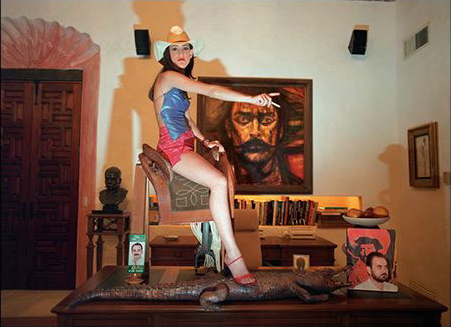
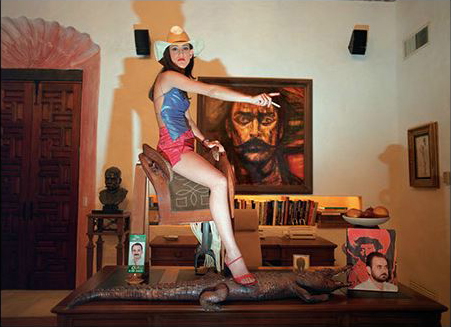
Rossell studied photography and visual arts in Mexico and later continued her education in the United States, where she was exposed to broader contemporary art practices. This combination of local and international training helped shape her conceptual approach. Rather than treating photography as simple documentation, she uses it as a tool to construct and frame narratives. Her images are deliberate, staged, and highly controlled, often blurring the line between reality and performance. Her breakthrough series Ricas y Famosas, created between the late 1990s and early 2000s, remains her most well known work. For this project, Rossell photographed women from wealthy and politically connected families in Mexico within their private residences. The images feature extravagant interiors filled with ornate furniture, luxury objects, religious iconography, and bold decorative choices. The subjects, often posed in glamorous or theatrical ways, appear both empowered and stylized, as if participating in a performance of status and identity.
What makes the series significant is not just its subject matter, but its ambiguity. Rossell does not present a straightforward critique or endorsement of wealth. Instead, she allows the images to operate in a space of tension. The photographs are visually seductive, drawing viewers in with color, texture, and opulence. At the same time, they can feel excessive, even unsettling, revealing layers of inequality and cultural contradiction. This duality has been central to the way her work has been interpreted, with some seeing it as satire, others as documentation, and many recognizing it as a complex mix of both.
Rossell’s background gave her unique access to these private environments. Rather than approaching her subjects as an outsider, she worked within social circles that allowed for a level of intimacy and trust. This proximity is evident in the images, which feel both candid and constructed. The subjects appear aware of the camera, participating actively in the creation of their own image. This dynamic raises questions about self representation, performance, and the role of the photographer in shaping meaning.
Beyond Ricas y Famosas, Rossell has continued to explore themes related to identity, gender, and cultural perception. Her work often engages with the idea of how people present themselves within systems of power, whether social, economic, or political. She is interested in surfaces, not just as visual elements, but as indicators of deeper structures. The spaces she photographs are never neutral. They reflect values, aspirations, and hierarchies embedded within society.
Rossell’s work has been exhibited internationally and is included in important collections, contributing to ongoing conversations about contemporary Latin American art. While her output has been relatively focused compared to some artists, her impact has been significant. Ricas y Famosas in particular remains a reference point for discussions about photography, class, and representation in Mexico and beyond.
Today, Daniela Rossell is regarded as an artist who used photography to expose and complicate perceptions of wealth and identity. Her images resist simple interpretation. They are at once alluring and critical, intimate and performative. By capturing the intersection of private space and public meaning, she created a body of work that continues to provoke reflection on how power and image are intertwined.
Represented By
Artworks by Daniela Rossell