Esteban Chartrand
Cuba, b. 1840 – d. 1884
Esteban Chartrand was a Cuban painter born in 1840, recognized as one of the most important landscape artists of nineteenth century Cuba. His work captures the natural beauty of the island with remarkable sensitivity, combining academic training with a poetic approach to light, atmosphere, and environment. Although his career was relatively short, his paintings remain central to the development of landscape painting in Cuban art.
Chartrand was born in Trinidad, Cuba, into a family with artistic inclinations. He showed an early interest in drawing and painting, and he pursued formal studies both in Cuba and abroad. Like many artists of his generation, he traveled to Europe to continue his training, where he was exposed to academic traditions and the influence of landscape painting as it developed in France and Spain. These experiences shaped his technical skills and broadened his understanding of composition and perspective.
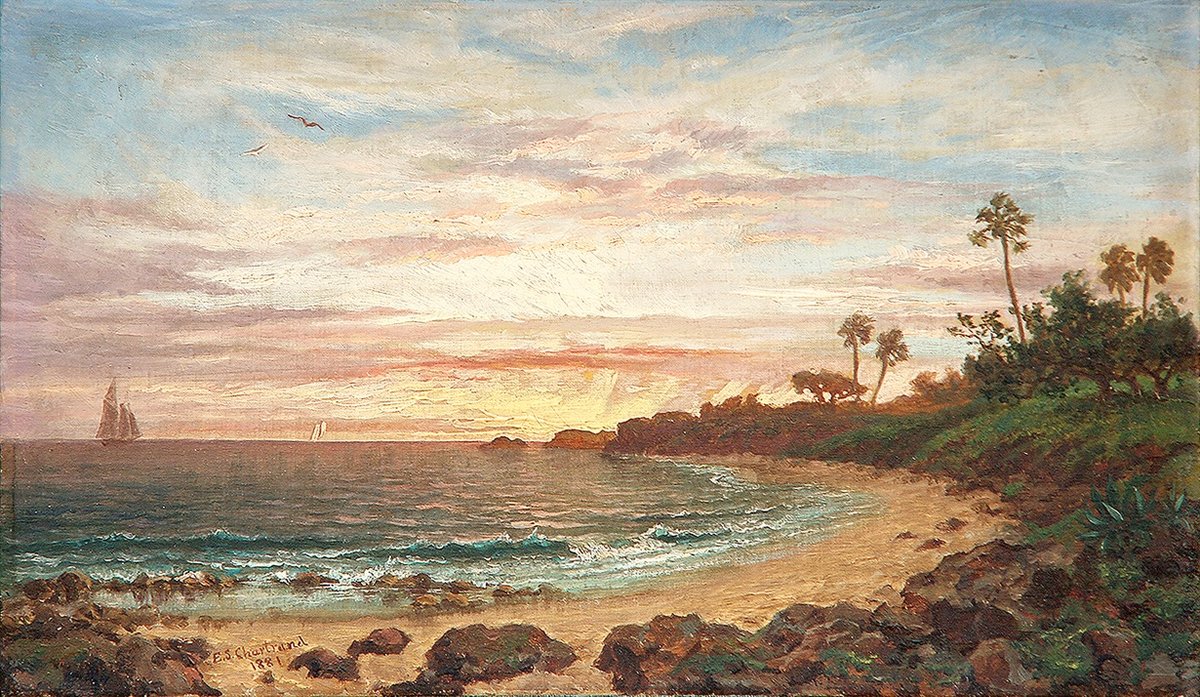
Upon returning to Cuba, Chartrand focused primarily on landscape painting, a genre that allowed him to engage directly with the island’s diverse terrain. His works often depict rural scenes, valleys, rivers, and mountain ranges, rendered with careful attention to detail and structure. At the same time, his paintings go beyond simple documentation. He approached the landscape with a sense of atmosphere, capturing the effects of light and the subtle variations of color that define different times of day.
A defining quality of Chartrand’s work is his ability to balance precision with mood. His compositions are carefully constructed, with a clear sense of depth and spatial organization. Foreground, middle ground, and background are handled with discipline, guiding the viewer through the scene. Yet within this structure, there is a softness in the handling of light and color that creates a sense of calm and harmony.
His palette often reflects the natural tones of the Cuban landscape, with greens, browns, and muted blues used to suggest vegetation, earth, and sky. Light plays a central role in his work, illuminating forms without overwhelming them. This controlled use of light contributes to the overall atmosphere, giving his paintings a sense of stillness and continuity.
Chartrand’s landscapes are notable for their lack of dramatic or overt narrative elements. Human presence is often minimal or absent, allowing the environment itself to become the primary subject. This focus reinforces the idea of the landscape as a space of observation and reflection rather than action. His work invites the viewer to engage quietly with the natural world.
Throughout his career, Chartrand gained recognition within Cuba for his technical skill and his ability to capture the essence of the island’s scenery. His paintings were appreciated for their clarity, balance, and refined execution. Despite his early death in 1884, his contribution to Cuban art has remained significant.
Today, Esteban Chartrand is regarded as a foundational figure in Cuban landscape painting. His work represents an important moment in the development of national artistic identity, where the natural environment became a subject of both artistic and cultural significance.
Through his careful observation and disciplined technique, he created a body of work that continues to define the tradition of landscape painting in Cuba.
Represented By
Artworks by Esteban Chartrand