Fernando Botero
Colombia, b. 1932 – d. 2023
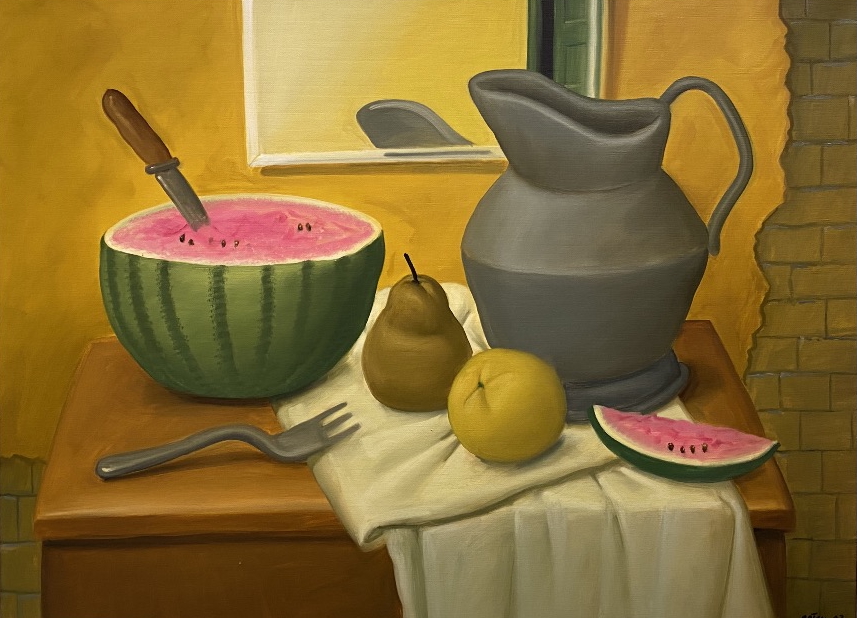
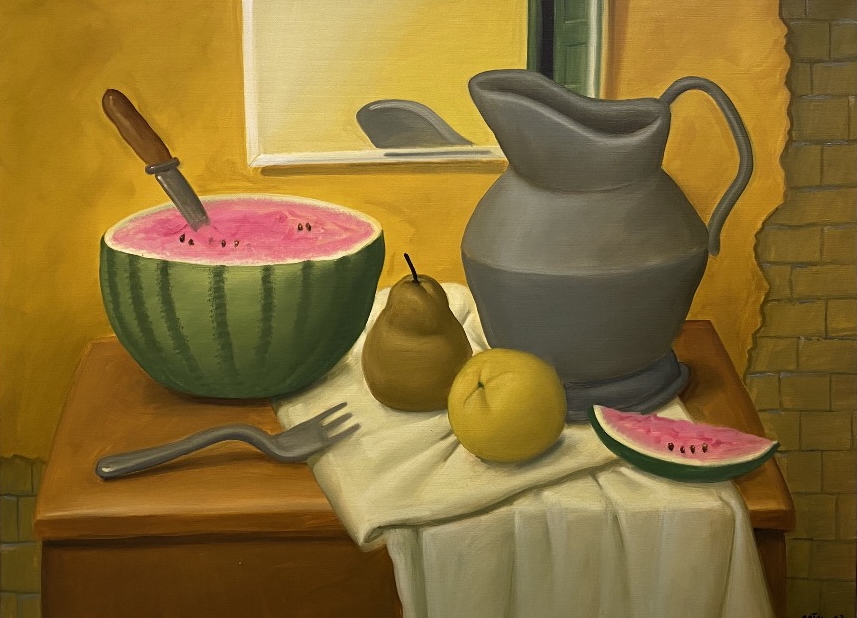
Fernando Botero was a Colombian painter and sculptor born in 1932 in Medellín, widely recognized for his distinctive style characterized by exaggerated volume and rounded forms. Over the course of a career that spanned more than six decades, he developed a unique visual language that has become instantly recognizable, often referred to as “Boterismo.” His work explores themes of power, identity, and everyday life through figures and objects rendered with monumental presence and deliberate distortion.
Botero showed an early interest in art and began his formal training as a young man in Colombia. In his formative years, he was influenced by local traditions as well as Spanish colonial art, particularly its emphasis on religious imagery and strong compositional structure. He later traveled to Europe, where he studied the work of Renaissance masters in Spain and Italy. These experiences had a lasting impact on his understanding of proportion, balance, and pictorial space, even as he moved toward a highly personal style.
A key turning point in Botero’s development came in the 1950s, when he began experimenting with proportion and scale. Rather than using distortion for humor alone, he used volume as a formal tool to explore space, surface, and presence. His enlarged figures are not simply caricatures; they are carefully constructed forms that emphasize mass and solidity. Through this approach, he created a visual language that transforms familiar subjects into something both playful and contemplative.
Botero’s subject matter is wide ranging. He painted scenes of daily life, portraits, still lifes, and historical references, often drawing from Colombian culture as well as broader global themes. His work frequently includes musicians, dancers, families, clergy, and political figures, all rendered with the same characteristic volume. Despite their often humorous appearance, these figures carry a sense of stillness and introspection, creating a contrast between form and emotion.
In addition to painting, Botero produced a significant body of sculptural work. His sculptures extend the same principles of volume into three dimensions, creating large scale bronzes that emphasize smooth surfaces and rounded forms. Many of these works are installed in public spaces around the world, where their scale and accessibility invite interaction. His sculptures have become landmarks in cities across Latin America, Europe, and the United States.
While Botero’s style is often associated with humor, his work also addresses more serious themes. In certain series, he confronted issues such as violence and political conflict, using his established visual language to explore difficult subject matter. These works demonstrate that his approach to form can carry both lightness and weight, depending on context.
Throughout his career, Botero achieved international recognition, exhibiting widely and gaining a global audience. His work is included in major museum collections, and he became one of the most prominent Latin American artists of the twentieth century. Despite his international success, he maintained a strong connection to Colombia, often referencing its culture and history in his work.
Fernando Botero died in 2023. He is remembered as an artist who transformed the language of figuration through his exploration of volume and proportion. His legacy lies in the creation of a style that is both accessible and complex, combining visual impact with deeper reflections on society, culture, and human experience.
Represented By
Artworks by Fernando Botero