Monica Castillo
Mexico, b. 1961
Mónica Castillo is a Mexican artist born in 1961 whose work is recognized for its introspective intensity and its exploration of identity, the body, and the inner life. Working across drawing, painting, installation, and performance, she has developed a practice that centers on the human figure, not as a stable or idealized form, but as a site of psychological tension, transformation, and vulnerability. Her work often feels direct and personal, inviting viewers into a space where emotion and perception are closely intertwined.
Castillo studied at La Esmeralda, the Escuela Nacional de Pintura, Escultura y Grabado in Mexico City, one of the country’s most important art institutions. There, she received formal training in drawing and painting, building a strong technical foundation that would support her later experimentation. During her formative years, she became interested in the expressive potential of the figure, particularly in how the body can communicate states of mind that are difficult to articulate through language. This focus would become central to her work.
Emerging in the 1980s, Castillo was part of a generation of Mexican artists who moved away from the dominant narratives of earlier decades, including the political and national themes associated with muralism. Instead, her work turned inward, emphasizing subjectivity, personal experience, and the complexities of perception. She became associated with a broader shift in Mexican contemporary art toward more conceptual and psychologically driven approaches.
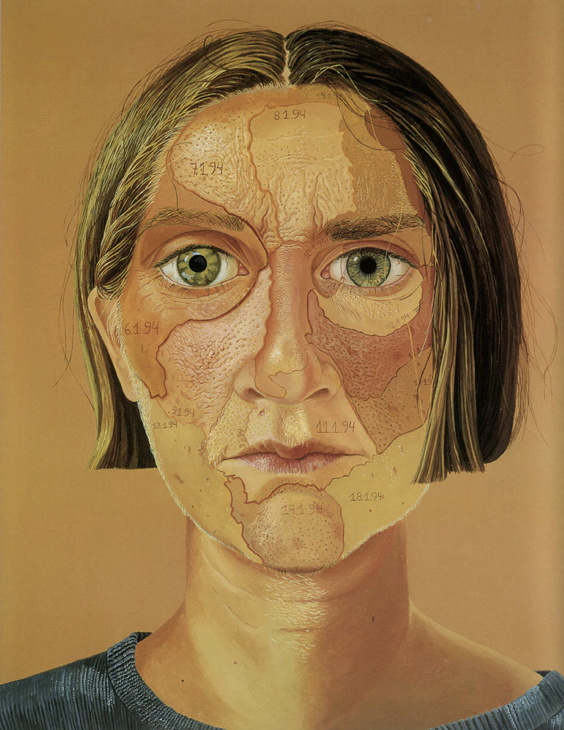
A defining feature of Castillo’s work is her use of the human figure as both subject and medium. Her drawings and paintings often depict bodies that appear fragmented, distorted, or in states of transformation. Faces may be partially erased or multiplied, and limbs may seem to dissolve into surrounding space. These distortions are not purely formal. They reflect an interest in how identity is constructed, perceived, and experienced. The body in her work becomes a space of questioning rather than certainty.
Her approach to materials and technique reinforces this exploration. Castillo often works with layering, repetition, and erasure, allowing traces of earlier marks to remain visible. This process gives her work a sense of accumulation, as if each image carries the history of its own making. Surfaces can feel both delicate and unsettled, with lines that shift between control and spontaneity. This balance mirrors the psychological themes she explores, where clarity and ambiguity coexist.
In addition to drawing and painting, Castillo has created installations and performances that expand her investigation of the body and perception into physical space. These works often engage the viewer more directly, encouraging a heightened awareness of presence, movement, and interaction. By moving beyond the flat surface, she emphasizes the idea that perception is not fixed, but shaped by context and experience.
Her work frequently addresses themes related to femininity, identity, and the internal experience of being seen and understood. While not overtly narrative, her images carry a strong emotional charge. They suggest introspection, tension, and the search for coherence within a fragmented sense of self. Rather than offering clear answers, Castillo’s work invites reflection and interpretation.
Throughout her career, Mónica Castillo has exhibited widely in Mexico and internationally, gaining recognition for her distinctive and thoughtful approach. Her work has been included in museum collections and exhibitions that highlight contemporary Latin American art. She has also been involved in teaching and artistic dialogue, contributing to the development of younger generations of artists.
Today, Mónica Castillo is regarded as an important figure in Mexican contemporary art. Her work stands out for its focus on the inner dimensions of experience, using the body as a means of exploring identity, perception, and transformation. Through careful technique and conceptual depth, she has created a body of work that continues to resonate with viewers seeking a more introspective and emotionally engaged form of art.