Oswaldo Guayasamín
Ecuador, b. 1919 – d. 1999
Oswaldo Guayasamín (1919–1999) Oswaldo Guayasamín, born in Quito in 1919 and later passing away in Baltimore in 1999, was one of Ecuador’s most important painters. From a young age, he showed a strong interest in drawing and painting, even selling his early works to tourists in order to fund his education. Despite initial opposition from his father, he enrolled in the School of Fine Arts in Quito, where he studied for seven years and graduated in 1941 as both a painter and sculptor, earning top honors in his class.
Guayasamín’s artistic training took place during the height of the Indigenist movement, which had a lasting influence on his early work. In 1942, he held his first exhibition in Quito, which sparked controversy due to its strong social and political themes. Shortly afterward, he traveled to Mexico, where he worked with the renowned muralist José Clemente Orozco, whose ideas and techniques played a key role in shaping Guayasamín’s artistic language.
In 1943, he spent several months in the United States visiting major museums and studying the works of masters such as Goya and El Greco. During this period, he also developed a friendship with the poet Pablo Neruda and undertook an extensive journey through Chile, Peru, Argentina, Bolivia, and Uruguay. This experience inspired his monumental series Huacayñán (“The Way of Tears”), composed of more than one hundred paintings that explore the lives and struggles of Indigenous, Afro-descendant, and mestizo peoples across Latin America.
This important body of work was made possible with the support of intellectual Benjamín Carrión and the newly established Casa de la Cultura. The Huacayñán series was first exhibited in 1952 at the Museum of Colonial Art in Quito and later shown in Washington, D.C., as well as at the Third Hispano-American Art Biennial in Barcelona, where it received the Grand Prize for Painting.
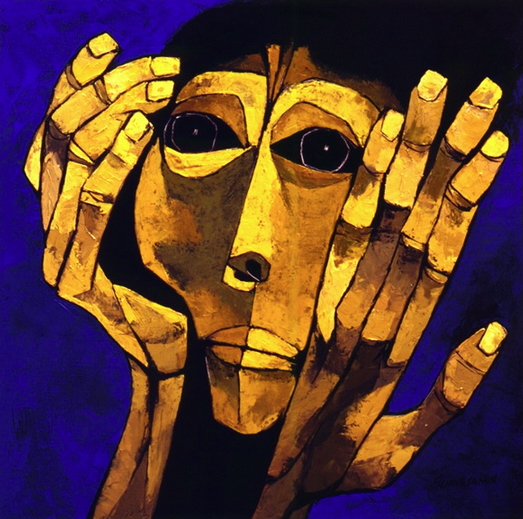
Guayasamín combined the emotional force of Indigenous themes with elements of early 20th-century avant-garde movements, particularly Cubism and Expressionism. These influences are evident in works such as Homage to the American Man (1954), a large-scale mural made with Venetian glass mosaic for the Simón Bolívar Center in Caracas. In 1957, he was awarded Best South American Painter at the São Paulo Biennial. During 1958, he created two major murals in Ecuador: The Discovery of the Amazon River, executed in Venetian mosaic and installed in the Government Palace in Quito, and History of Man and Culture for the Faculty of Jurisprudence at the Central University of Ecuador. In 1960, he received the Grand Prize at the Second Mexican Biennial of Painting, Sculpture, and Printmaking, marking the beginning of his international recognition. After years of intense work, in 1968 he presented his second major series, The Age of Anger, at the Museum of Fine Arts in Mexico City. This powerful body of work, consisting of 260 pieces grouped into thematic sections such as Hands, Heads, The Face of Man, Concentration Camps, and Crying Women, reflects the suffering, violence, and tragedy of the modern human condition.
The Age of Anger is considered one of the last great expressions of politically engaged painting in the 20th century. Following its exhibition in Mexico, it was shown internationally in 1973 in Barcelona, Prague, and Paris. In 1971, Guayasamín also created the sculptural monument The Young Homeland in Guayaquil, and the following year the Museum of Contemporary Art in Madrid hosted an exhibition of his recent work.
In 1973, he was appointed vice president and later president of the Casa de la Cultura in Quito, where he led significant cultural initiatives. In 1974, he received a major distinction from the French government, becoming one of the first Latin American artists to be honored in this way. In 1977, a major retrospective of his work was organized in Quito, with part of the exhibition also presented in several cities in Spain. In 1980, he unveiled the mural Ecuador at the Provincial Council of Pichincha, and in 1982 completed Spain–Hispanic America, located at Madrid’s Barajas International Airport.
In 1981, Ecuador’s National Congress recognized the importance of his legacy by establishing the Guayasamín Foundation, to which the artist donated his works and personal collections. Throughout his career, Guayasamín consistently used his art to denounce injustice, violence, and human suffering, giving his work a powerful emotional intensity and securing his place as a central figure within Latin American Indigenist art.
Represented By
Artworks by Oswaldo Guayasamín