Rafael Coronel
Mexico, b. 1931 – d. 2019
Rafael Coronel was a Mexican painter born in 1931 in Zacatecas who became one of the most distinctive figures in modern Mexican art. Known for his haunting imagery, subdued palette, and deeply introspective themes, he developed a body of work that stood apart from the dominant traditions of his time. While many Mexican artists of earlier generations were associated with large scale muralism and overt political narratives, Coronel moved in a more personal and psychological direction, focusing on solitude, memory, and the human condition.
He was born into an artistic family. His younger brother, Pedro Coronel, also became a well known artist, though their styles diverged significantly. Rafael Coronel initially studied architecture before turning fully to painting, a shift that allowed him to pursue a more expressive and individual path. Early in his career, he received encouragement from Diego Rivera, who recognized his talent and helped bring attention to his work. Despite this connection, Coronel did not follow Rivera’s approach. Instead, he developed a quieter and more introspective style that emphasized mood over narrative.
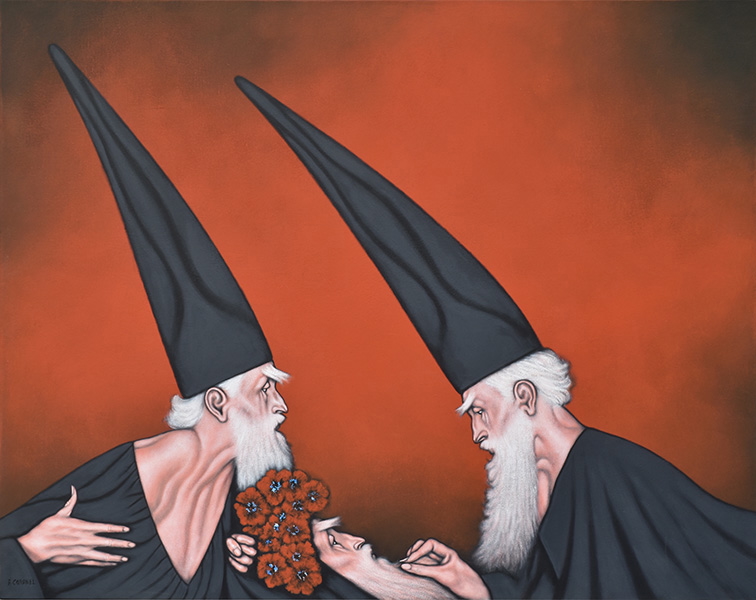
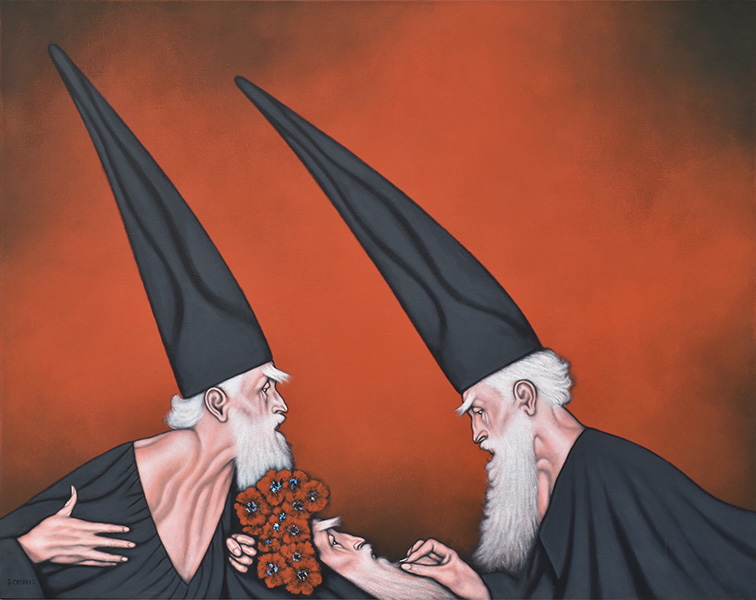
Coronel’s paintings are often populated by solitary figures that appear suspended in undefined spaces. These figures are frequently elongated, blurred, or partially obscured, giving them a ghostlike presence. Rather than depicting specific individuals, he created archetypal forms that suggest universal states of being. His work often evokes themes of isolation, melancholy, and introspection, inviting viewers to engage with emotional and psychological depth rather than external action.
One of the defining features of his work is his use of color. Coronel favored a restrained palette dominated by grays, muted reds, browns, and soft earth tones. This limited range enhances the atmospheric quality of his paintings, creating a sense of quiet tension and ambiguity. His surfaces often appear worn or aged, as if the images have emerged slowly over time. This treatment reinforces the sense of memory and timelessness that runs throughout his work. In addition to painting, Coronel developed an important parallel practice as a collector. Over many years, he assembled an extensive collection of masks from Mexico and other parts of the world. These objects, rich in cultural and ritual significance, had a profound influence on his artistic thinking. The mask as a concept, suggesting identity, concealment, and transformation, resonates strongly with the figures in his paintings. Eventually, his collection became the foundation for the Rafael Coronel Museum in Zacatecas, housed in a former convent. The museum is now one of the most significant collections of masks in Latin America.
Coronel also created murals and other large scale works, though he remained primarily known for his paintings. His approach to art was consistent in its focus on interior experience rather than public narrative. He avoided overt political messaging, instead exploring themes that are more universal and enduring. His work reflects a deep engagement with human emotion, as well as a sensitivity to silence and space.
Throughout his career, Rafael Coronel exhibited widely in Mexico and internationally, gaining recognition for his unique contribution to modern art. While his work may appear understated compared to more dramatic or colorful traditions, its strength lies in its restraint and emotional intensity. He created images that do not demand attention loudly, but instead draw the viewer in gradually.
Rafael Coronel died in 2019. Today, he is remembered as a major Mexican artist who expanded the possibilities of figurative painting through subtlety and depth. His legacy lies in his ability to evoke powerful emotional states with minimal means, creating a body of work that continues to resonate with quiet force.